Key Takeaways
- Business proof of address is a dated third-party document, usually a lease, utility bill or bank statement, that shows your company name (or, on some platforms, the owner’s name) and the full street address of the place you operate.
- A signed, current lease is on the list at every bank and fintech in this guide, and at Stripe and Amazon. A recent utility bill or bank statement is the most widely accepted document overall, but the date window varies.
- Date windows differ: Mercury wants 90 days, Wise and Brex 3 months, Stripe, Relay and Shopify 6 months, Amazon 180 days and PayPal 12 months. A document from the last 90 days works everywhere.
- PO boxes are rejected as the business address on every platform we checked. Mercury, Relay, Wise, Brex, Google and Stripe also reject virtual mailboxes and CMRA addresses as the operating address.
- US law doesn’t name a proof-of-address document. Banks must verify a “principal place of business, local office, or other physical location” and choose their own evidence, which is why every list is different.
- Keep one address story across the IRS, your state filing, your bank and your platforms. Each platform sets its own rules, so check the linked page before you upload.
What proof of address for a business means
Proof of address for a business is a document issued by someone other than you that shows your company’s name and the street address where it operates, with a recent date. Banks, payment processors and marketplaces ask for it when they can’t confirm your address from the data you typed in.
The request comes from Know Your Customer (KYC) rules. Under the federal Customer Identification Program rule, a bank must collect an address for every customer. For a company, that address is “a principal place of business, local office, or other physical location” (source). Fintechs that open accounts through partner banks, and payment platforms that move money, apply the same idea: they want to know where the business really is.
Legal address vs operating address
Most platforms keep 2 business addresses, and proof of address is almost always about the second one:
- Legal or registered address. The address on your formation documents. Relay says a registered agent address “may serve as your business’s legal address” (source), and Wise says the registered address “could be the address of the registration agency you used” (source).
- Operating, trading or physical address. Where the business actually works. Stripe asks for “the physical location where the majority of your business activity is carried out” (source). Wise calls it the trading address and says it “must be a physical location” (source).
When a platform asks for business proof of address, it wants a document for the operating address. The owner’s home address is a third, separate field, and it has its own document rules.
Business proof of address documents that are accepted
These are the documents that show up on bank and platform lists, with who accepts each one. “Listed” means the platform names it on its own help page. It doesn’t mean the platform will approve your file: each one verifies the address its own way.
| Document | Listed by | Watch out for |
|---|---|---|
| Signed lease or rental agreement | Stripe, Mercury, Relay, Wise, Brex, Amazon | Stripe wants the signatures of the landlord and the tenant. Relay wants it “still active”. Brex accepts one issued in the past 2 years. |
| Utility bill (electric, gas, water, internet) | Stripe, Mercury, Relay, Wise, Brex, Shopify, Amazon, PayPal | Wise rejects mobile phone bills. Relay and Amazon accept them. |
| Bank or credit card statement | Mercury, Relay, Wise, Brex, Shopify, Amazon, PayPal, eBay | Wise won’t take Mercury statements. Mercury and Stripe won’t take their own. |
| Tax return or tax notice | Stripe, Mercury, Wise, Shopify, Amazon, PayPal | Stripe’s appeal list wants filed returns from the last 24 months. |
| Business insurance policy or statement | Stripe (appeals), Relay, Wise, Shopify, PayPal | Wise allows up to 12 months old. |
| Business license, registration or articles | Stripe, Wise, Shopify, Amazon, PayPal | Stripe’s appeal list wants articles “that provide the principal address”. |
| Mortgage statement | Stripe (appeals), Mercury, Amazon | Stripe and Mercury want it from the last 6 months or 90 days. |
| Coworking agreement or invoice | Mercury, Wise | Google only accepts coworking addresses with signage and staff during business hours. |
Sources: Stripe, Stripe appeal list, Mercury, Relay, Wise, Brex, Shopify, Amazon, PayPal, eBay, Google.
Documents that don’t work
- Envelopes, invoices, receipts and waybills. PayPal names all four as not accepted (source). The exception is Mercury, which accepts a “Subscription invoice from the last 90 days” (source).
- Screenshots and edited files. Stripe: “Screenshots aren’t acceptable” (source). Shopify: “Don’t photocopy, scan, or screenshot your documents” (source).
- Handwritten documents. Amazon: “A valid proof of address cannot be handwritten” (source).
- Money-transfer receipts. Relay rejects receipts from Western Union, MoneyGram, Ria and Wise (source).
- Expired, partial or cropped documents. PayPal rejects “Expired, partial, or obscured documents” (source).
How recent does proof of address need to be?
It depends on the platform, and the spread is wide: from 90 days to 12 months for bills and statements. If you plan to use several platforms, get a document dated in the last 90 days. It clears every window in the table.
| Platform | Date window | Exact wording |
|---|---|---|
| Mercury | 90 days (bills, statements, invoices) | “Utility bill or mortgage statement from the last 90 days” |
| Wise | 3 months (bills, statements, licences); 12 months (tax bills, insurance) | “must be less than 3 months old” |
| Brex | 3 months (bills, statements); 2 years (lease) | “A utility bill issued within the last 3 months” |
| eBay | 3 months (bank statement) | “Is 3 months old or less” |
| Stripe | 6 months (appeal list); 24 months (filed tax returns) | “Utility bill from the last 6 months” |
| Relay | 6 months | “dated within the last six months” |
| Shopify Payments | 6 months | “a date of issuance within the past 6 months” |
| Amazon | 180 days | “Must be issued within the last 180 days” |
| PayPal | 12 months | “All documents must be dated within the last 12 months” |
Sources: Mercury, Wise, Brex, eBay, Stripe, Relay, Shopify, Amazon, PayPal. Checked September 2026.
Which date counts
The issue date, not the date you upload. Amazon accepts “the issuing date, due date, or transaction dates” (source). A lease is different: platforms check that it is signed and still running, so the start date can be older. Relay accepts a lease “provided it is still active” (source).
Proof of address requirements by platform
Here is what each platform says on its own help page about the business address and the documents that prove it. Each platform sets its own rules and changes them without notice, so open the linked page before you upload.
| Platform | Business address rule | Documents it lists | Name on the document |
|---|---|---|---|
| Stripe | Physical location of most business activity. No PO box. Mailbox and virtual address services don’t count as physical presence. | Signed lease, utility bill, federal or state tax return, articles or other government business document. | Business name or the account owner’s name. |
| Mercury | US physical address. No PO box, virtual address, CMRA, mail center or registered agent for the physical address. | Signed lease; utility bill, mortgage, bank or card statement from 90 days; coworking lease or invoice; latest tax documents. | Company name or a beneficial owner’s name. |
| Relay | Physical street address. No PO box or virtual mailbox. A registered agent can be the legal address only. | Utility bill (mobile and internet count), bank statement, active lease, pay stub, insurance statement. | The owner’s full name and the business name. |
| Wise | Trading address must be a physical location. No PO box or virtual office. Coworking is allowed. | Business licence, registration, utility bill, bank statement (3 months); tax bill, insurance (12 months). | Business name (not stated for owners). |
| Brex | No PO box, PMB or mailbox service. | Utility bill or bank statement (3 months), lease (2 years). | Not stated. |
| PayPal | Physical address only, “not PO Box addresses”. | Utility or phone bill, insurance or tax statement, business license, Certificate of Good Standing, bank statement, state filings (12 months). | “Full business name” on bank statements. |
| Shopify Payments | Account address must match the document. | Utility bill, bank or card statement, insurance statement, tax assessment, business registration (6 months). | Match the account details. |
| Amazon | Not stated on the address page. | Bank, card or payment-provider statement, utility bill, lease, mortgage, tax document, business license (180 days). | Business or entity name for Professional sellers. |
| eBay | Physical place of business. No PO box. | Bank statement (3 months) with bank name and last 4 digits. | Your name or legal business name. |
| Google Business Profile | No PO box, remote mailbox or virtual office. Coworking only with signage and staff. | In video verification: business permit, invoice or utility bill. | Must match the Business Profile name. |
Each of these has more detail than fits in a row. Our deep dives cover Stripe business verification, Mercury’s address requirements, Relay and Wise and Amazon seller identity verification.
Google Business Profile is a special case
Google doesn’t ask for a document up front. It verifies by phone, text, email, live video, recorded video or postcard, and “Most codes arrive within 14 days” (source). In a recorded video you show your location and a “business permit, invoice, or utility bill that matches the name on your Business Profile”, in at least 30 seconds of unedited footage (source). A document alone won’t fix an ineligible address: a virtual office “isn’t eligible for a Business Profile” (source).
Proof of Address for Business
Unlock the Full Guide & Checklist
Enter your business email to read the rest of this breakdown, download the PDF edition, and receive official compliance updates.
Whose name must be on the document
Most rejections that aren’t about the date are about the name. Platforms split into 2 groups.
Business name or owner’s name
- Stripe: “All documents must include either the name of your business or the name of the owner of the Stripe account” (source).
- Mercury: the document must “clearly show the company name, or the beneficial owner’s name, along with the full physical address” (source).
- Relay: it must “display the full name of the owner and business” (source).
Business name required
- Amazon: “Professional sellers: Must contain the name of the business or entity” (source).
- PayPal: a “Current bank statement displaying full business name” (source).
- Google: the document must match “the name on your Business Profile” (source).
How to avoid a name mismatch
- Use the legal name exactly as it appears on your formation documents and IRS records, including “LLC” or “Inc.”
- If you trade under a DBA, put the legal name on the account and on the document, or upload something that shows both.
- Open the utility account, lease and bank account in the company’s name, not yours, when you can. It is the version every platform accepts.
- Check the address line too. A missing suite number is a mismatch. Shopify says your account address “must be updated to match” the document (source).
PO boxes, virtual mailboxes and registered agent addresses
A PO box is rejected as the business address on every platform in this guide. Private mailboxes (PMBs) at a Commercial Mail Receiving Agency (CMRA), which is what a virtual mailbox is, are rejected by most of them as the operating address. A document that proves a mailbox address doesn’t change that.
| Platform | PO box | Virtual mailbox / CMRA | Registered agent |
|---|---|---|---|
| Stripe | No | No as physical presence; rejected for Issuing and Treasury | Rejected for Issuing and Treasury |
| Mercury | No | No | No (physical address) |
| Relay | No | No | Legal address only |
| Wise | No | No | Registered address only |
| Brex | No | No | Not stated |
| Google Business Profile | No | No | Not stated |
| PayPal | No | Not stated | Not stated |
| eBay | No | Not stated | Not stated |
| Amazon | Not stated | Not stated | Not stated |
Sources: Stripe, Stripe Issuing and Treasury, Mercury, Mercury eligibility, Relay, Wise, Brex, Google, PayPal, eBay. “Not stated” means the platform’s page says nothing either way.
Why mailbox addresses fail
A CMRA address carries a “PMB” or “#” designator by USPS rule (source), and Stripe says openly that it now screens out “addresses associated with mailbox services and virtual address services” (source). Stripe’s list for Issuing and Treasury names “UPS Stores, FedEx Office locations, or virtual mail services” (source). The address is a place where mail arrives, not a place where the business operates, and the platforms that ask for a physical address are asking for the second thing.
A mailbox is still useful: it receives your mail and keeps your home address off public filings. It just isn’t the address you prove. Our guide to CMRA addresses explains how platforms spot them.
Registered agent addresses
A registered agent accepts legal papers for your company in its state. Relay and Wise accept the agent’s address as the legal or registered address, but not as the operating address (source). Mercury lists “registered agent addresses” as not accepted (source). Stripe allows that a registered agent address “might legitimately reflect the business’s location” for some professional firms, such as law firms (source).
Proof of address for a business bank account
Banks work from the Customer Identification Program (CIP) rule, 31 CFR 1020.220. For a company, the address must be “a principal place of business, local office, or other physical location” (source). The rule lets each bank choose documents, “non-documentary methods, or a combination of both”, and non-documentary checks include comparing your data with “a consumer reporting agency, public database, or other source” (source).
In practice that means 2 things. A bank may never ask you for a document if its database check matches. And when it does ask, the list is the bank’s own, not a legal one.
Why banks won’t take a PO box
The CIP rule itself doesn’t mention PO boxes. The regulators’ guidance does: a rural route number is acceptable because, “unlike a post office box number”, it describes where the customer can be found (source). FinCEN has also said a bank “would not be in compliance” if it accepted a state address-confidentiality PO box for CIP (source).
Owners need their own proof
The beneficial ownership rule, 31 CFR 1010.230, verifies each owner with the same elements as an individual customer: a residential or business street address (source). Bank of America asks owners for a “residential address” (source), and Chase says “Proof of address or date of birth may be required” (source). Expect to prove 2 addresses: the company’s and your own.
Fintech banks
- Mercury won’t accept “P.O. Box addresses or virtual offices/workspaces as a company’s legal address” (source), but accepts “A verifiable residential address (if your company doesn’t have an office yet)” as the physical address (source).
- Relay needs documents in PDF and English, dated within 6 months (source).
- Wise allows a co-working space as the trading address and rejects mobile phone bills (source).
- Brex rejects “USPS P.O. Boxes, private mailboxes (PMBs), or other mailbox services” (source).
Keep the IRS and state records on the same address
Platforms compare what you type with other records. The IRS and your state hold 2 of them, so the address there should tell the same story as your proof of address.
The IRS: mailing address vs street address
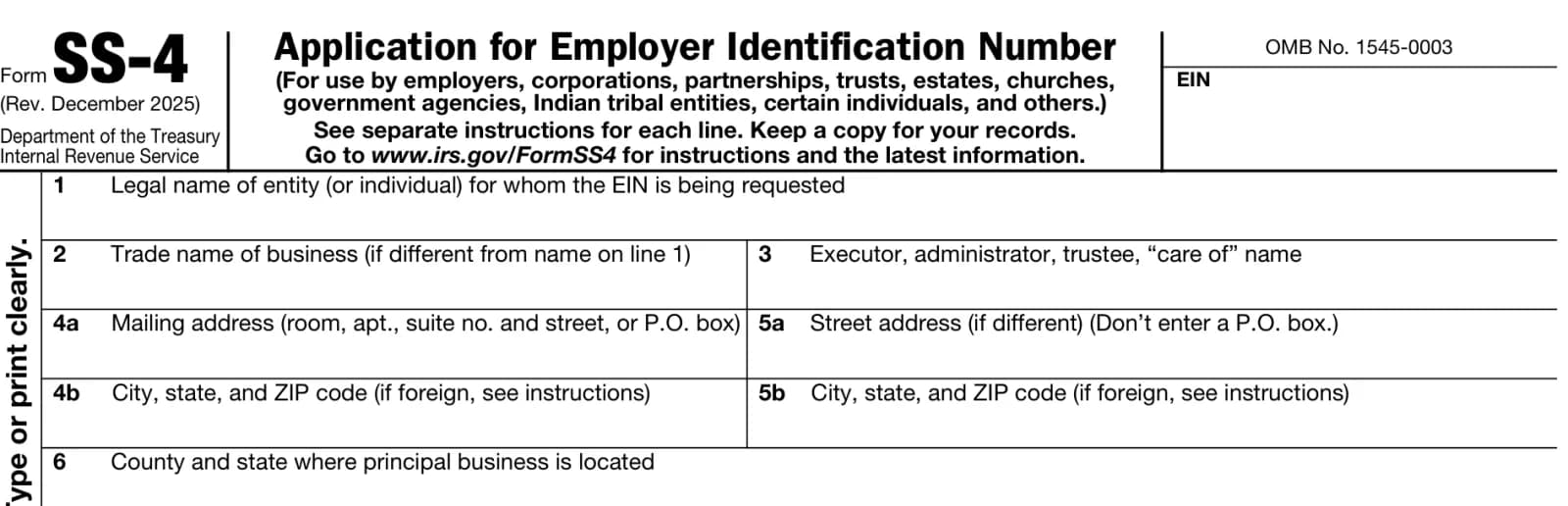
Form SS-4, the EIN application, has separate lines. Line 4a is the mailing address and can be a PO box. Line 5a is the street address, with the instruction “Don’t enter a P.O. box”, and line 6 asks for the county and state “where principal business is located” (source). The instructions add that the mailing address “will be used on all tax returns” (source).
Changing your business address with the IRS
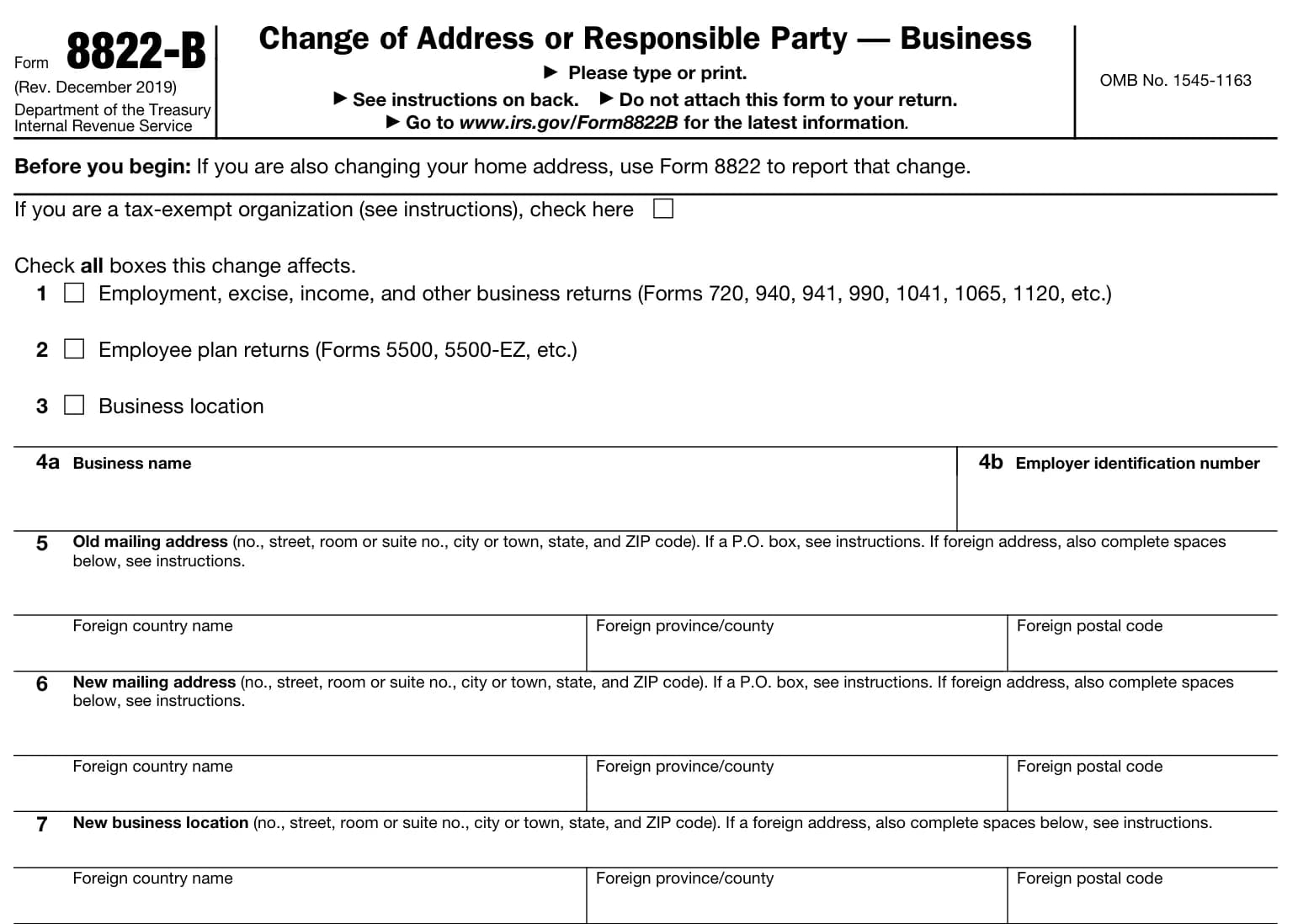
Use Form 8822-B for a new “business mailing address, your business location, or the identity of your responsible party” (source). It takes “4 to 6 weeks” to process, and a change of responsible party must be reported “within 60 days” (source). The IRS doesn’t ask for a proof-of-address document with it. Enter a PO box “only if your post office does not deliver mail to your street address” (source).
State filings
States care most about the registered office. Wyoming says it “shall be a physical location where an individual can accept service of process” and that PO boxes, virtual addresses and mail-forwarding locations “do not qualify” (source). Delaware requires the registered office address to include “the street, number, city and postal code” (source). If you haven’t formed the company yet, Registate handles formation and state choice, and our LLC state comparison covers the trade-offs.
Proof of address for a mailbox: USPS Form 1583
Opening a mailbox is the one place where you prove a personal address, not a business one. PS Form 1583 needs 2 IDs: “One ID must be a government-issued photo ID. The second must confirm the Applicant’s… address listed on this form” (source).
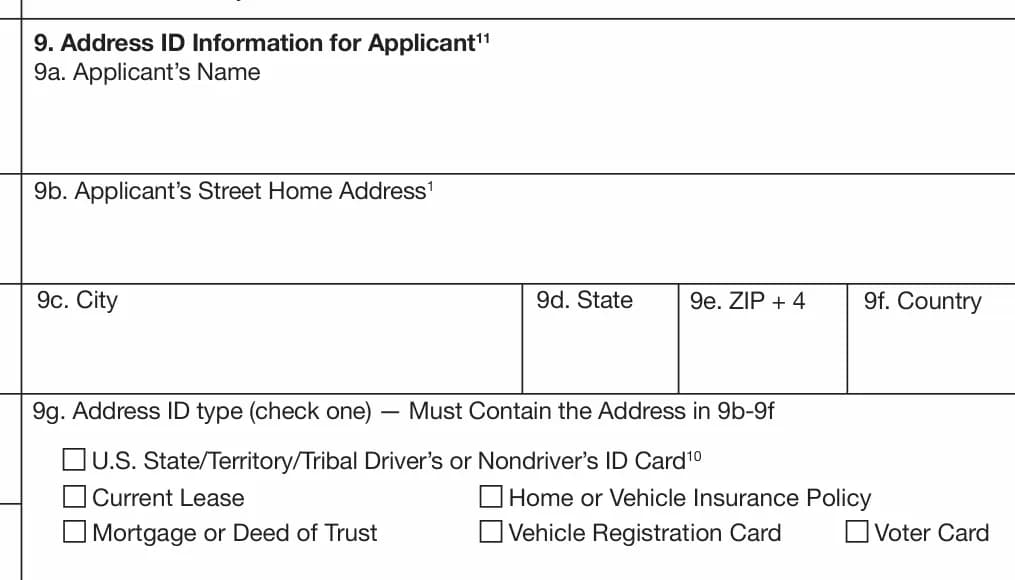
Utility bills were dropped in 2023: “Corporate identification cards and utility bills are no longer acceptable forms of identification” for Form 1583 (source). A driver’s license can be the photo ID or the address ID, “not for both” (source). USPS rules also accept Form I-94 as a secondary ID and reject Social Security cards, birth certificates and credit cards (source).
You sign in front of the mailbox operator, in person or on a live video call, or in front of a notary (source). Our Form 1583 handbook walks through every field. You can also start it on the Form 1583 page.
How to get proof of address for a new LLC
A new company has no bills yet, which is where most founders get stuck. These are the routes the platform lists allow, from cheapest to most complete.
- 1Use your home, if the platform allows it. Mercury accepts “A verifiable residential address (if your company doesn’t have an office yet)” (source). Your own utility bill or bank statement then works, because Mercury, Stripe and Relay accept the owner’s name.
- 2Put a utility or internet account in the company’s name. Stripe, Mercury, Relay, Wise, Brex, Shopify, Amazon and PayPal all list a utility bill. The first bill gives you a dated document at the operating address.
- 3Open the business bank account, then use its statement. Most lists take a bank statement. Check the source rule first: Wise won’t take Mercury statements (source), and Stripe won’t take statements through Stripe (source).
- 4Sign a coworking agreement. Mercury accepts “Proof of occupancy at a coworking space such as a signed lease agreement or invoice” (source) and Wise allows coworking addresses. For Google, the space needs signage and staff during business hours (source).
- 5Sign a commercial lease. A signed, active lease is on the Stripe, Mercury, Relay, Wise, Brex and Amazon lists, and it gives you an operating address to put a utility account on.
Non-US founders
A US LLC owned from abroad still needs a US operating address on most platforms, and the founder’s foreign home address is proved separately with a personal document. Stripe’s cross-border fallback is a utility bill or bank statement “issued within the last 6 months” (source). Chase’s ID list says non-US persons without a green card need a US address on one of their IDs (source). If you have no US office and no US home, a mailbox address won’t fill that gap on the platforms above.
Business proof of address checklist before you upload
Run through this list before any upload. Most rejections come from one of these lines.
Frequently asked questions
What is proof of address for a business?
It’s a recent document from a third party, such as a lease, utility bill, bank statement or tax notice, that shows your company’s name (or, on some platforms, the owner’s name) and the street address where the business operates.
What documents can I use as business proof of address?
A signed lease, a utility bill, a bank or credit card statement, a tax return or notice, a business insurance policy, or a business license that shows the address. A recent utility bill is the most widely listed; a signed, active lease is accepted by every bank and fintech we checked.
How recent does proof of address need to be?
Usually 90 days to 12 months, depending on the platform. Mercury wants 90 days, Wise and Brex 3 months, Stripe, Relay and Shopify 6 months, Amazon 180 days and PayPal 12 months. A document from the last 90 days works everywhere.
Can I use a PO box as proof of business address?
No. Every platform we checked rejects a PO box as the business address, and bank CIP guidance treats a PO box as not describing where a customer can be found. You can still use one as a mailing address, for example on IRS Form SS-4 line 4a.
Can I use a virtual mailbox address for bank verification?
Not as the operating or physical address at Mercury, Relay, Wise or Brex, and Stripe no longer counts mailbox or virtual address services as physical presence. A virtual mailbox handles your mail; it isn’t proof of where the business operates.
Can I use my home address as my business address?
Often, yes. Mercury accepts a verifiable residential address if your company doesn’t have an office yet, and Stripe, Mercury and Relay accept documents in the owner’s name. Your home address may become public in state filings, so check that first.
Is a mobile phone bill proof of address?
It depends on the platform. Relay and Amazon accept mobile phone bills, and PayPal accepts a phone bill. Wise says it can’t accept mobile phone bills. Use an electric, gas, water or internet bill if you want one document for every platform.
Does the document have to be in the company’s name?
Not always. Stripe accepts the business name or the account owner’s name, Mercury the company or a beneficial owner, and Relay wants the owner and business names. Amazon (Professional sellers) and PayPal want the business name. A document in the company’s name works on all of them.
Is a registered agent address a valid business address?
Only as the legal or registered address, and only on some platforms. Relay and Wise accept it there. Mercury rejects registered agent addresses, and Stripe screens them out for Issuing and Treasury. None accept it as the operating address.
Is an invoice proof of address?
Usually not. PayPal rejects invoices, receipts and waybills. Mercury is the exception: it accepts a subscription invoice from the last 90 days and a coworking invoice.
What proof of address does the IRS need?
None as a document. You report addresses on Form SS-4 and change them on Form 8822-B, which takes 4 to 6 weeks to process. The SS-4 street address line can’t be a PO box.
Is a utility bill accepted for USPS Form 1583?
No. Since July 2023 USPS doesn’t accept utility bills for Form 1583. The address ID must be a driver’s or non-driver ID card, lease, mortgage or deed of trust, home or vehicle insurance policy, vehicle registration or voter card.
How do I get proof of address for a new LLC?
Put a utility or internet account in the company’s name, use the first business bank statement, sign a coworking agreement, or sign a commercial lease. Where allowed, a residential address with a bill in the owner’s name also works.