Key Takeaways
- US companies are permanently exempt from BOI reporting. FinCEN’s final rule took effect on August 14, 2026, and covers every LLC and corporation formed in a US state, including those owned 100% by non-US founders.
- Only a "foreign reporting company" still files: an entity formed under another country’s law and registered to do business in a US state. It files within 30 calendar days of that registration.
- A foreign reporting company reports only its non-US beneficial owners and non-US company applicants. US persons are exempt on both sides.
- The company address on a BOI report is a US street address where the company does business. FinCEN says a PO box can’t be used.
- Willful violations still carry a civil penalty of $606 per day and criminal fines up to $10,000, but only for foreign reporting companies and non-US persons.
- No BOI filing doesn’t mean no ownership check. Banks still collect beneficial ownership under FinCEN’s separate Customer Due Diligence Rule.
BOI reporting in 2026: the short answer
BOI reporting (beneficial ownership information reporting) is the filing the Corporate Transparency Act (CTA) created so FinCEN, the Treasury’s financial-crimes bureau, knows who owns and controls a company. In 2026 the answer to "do I have to file?" is almost always no. On August 11, 2026, FinCEN issued a final rule that "eliminates the requirement for U.S. companies and U.S. persons to report beneficial ownership information" (FinCEN). It was published and took effect on August 14, 2026 (Federal Register).
FinCEN’s BOI page now opens with the same message: US companies are exempt from the BOI reporting requirements, reporting companies don’t report BOI for US-person beneficial owners, and US persons don’t have to give their BOI to reporting companies (FinCEN).
Who still files a BOI report
Only a company formed under the law of a foreign country that has registered to do business in a US state or tribal jurisdiction by filing with a secretary of state or similar office (FinCEN final rule Q&A 3). FinCEN estimates about 28,000 such companies are not exempt, and about 13,000 had filed by the end of 2025 (Federal Register, 91 FR 52520).
| Your company | BOI report due? | Why |
|---|---|---|
| US LLC or corporation, US owners | No | Every US-formed entity is exempt |
| US LLC or corporation, non-US owners | No | What counts is where the entity was formed, not who owns it |
| Delaware LLC also registered in Texas or New York | No | It’s "foreign" only in state-law terms. It was still formed in the US |
| UK, Indian or other non-US company registered in a US state | Yes, unless exempt | This is the "foreign reporting company" FinCEN still covers |
| Non-US company not registered in any US state | No | No US registration filing, so it isn’t a reporting company |
Who must file BOI: the foreign reporting company test
Since March 26, 2025, the rule defines a reporting company as any corporation, LLC or other entity that is (A) formed under the law of a foreign country and (B) registered to do business in any US state or tribal jurisdiction by filing a document with a secretary of state or similar office. The same rule adds a "domestic entity" exemption for anything created by filing with a US secretary of state (interim final rule, 90 FR 13688). The August 2026 final rule adopted that text as permanent (Federal Register).
Both tests have to be true
- Formed abroad. The company’s legal existence comes from another country’s law: a UK private limited company, an Indian private limited, a German GmbH, a Canadian corporation.
- Registered in a US state. It has filed to do business in a US state, usually called foreign qualification or an application for authority. A company that only sells into the US online, without that filing, isn’t a reporting company.
The 23 exemptions still apply
A foreign company that meets both tests can still be exempt. FinCEN keeps 23 exemption types (FinCEN FAQ C.2), including banks, SEC-reporting issuers, registered money services businesses, tax-exempt entities, subsidiaries of certain exempt entities and "large operating companies" (31 CFR 1010.380(c)(2)).
The large operating company exemption is the one foreign groups most often use. It needs all 3: more than 20 full-time employees in the US, an operating presence at a physical office in the US, and a prior-year US tax or information return showing more than $5,000,000 in US gross receipts or sales.
What "US person" means here
The exemptions for people turn on being a "United States person" as the tax code defines it in section 7701(a)(30) (31 CFR 1010.380(f)(10)). That covers US citizens and residents, domestic partnerships and corporations, and most estates and certain trusts (IRS). A non-US founder living abroad isn’t a US person.
BOI reporting for non-US founders with a US LLC
If you formed an LLC or corporation in Delaware, Wyoming, New Mexico or any other state, you have no BOI filing, whatever your nationality or where you live. The exemption turns on where the entity was formed, and yours was formed in the US (31 CFR 1010.380(c)(2)(xxiv)). FinCEN’s Q&A says it plainly: reporting companies now "include only those entities that are formed under the law of a foreign country" (Q&A 3).
Why "foreign LLC" confuses people
State law calls a Delaware LLC registered in Texas a "foreign LLC" in Texas. The BOI rule doesn’t use the word that way. For BOI, "foreign" means formed under another country’s law. So a Wyoming LLC qualified in California stays exempt.
When a non-US founder does file
You file if you run the business through a company formed at home, say a UK Ltd, and that company registers to do business in a US state. It then reports itself and its non-US beneficial owners, which probably includes you.
What you still owe as a foreign-owned US LLC
- IRS Form 5472 each year if your single-member LLC is foreign-owned. The IRS assesses a $25,000 penalty for failing to file it (IRS).
- Bank ownership checks. Banks still collect beneficial ownership when you open an account (more below).
- State filings such as annual reports and a registered agent, which depend on your state. Registate covers state choice and formation for non-US founders.
BOI reporting deadline in 2026
For foreign reporting companies, the deadlines come from the March 2025 interim final rule and are unchanged by the final rule (90 FR 13688; final rule Q&A 12).
| Situation | Deadline |
|---|---|
| Registered in a US state before March 26, 2025 | Initial report was due April 25, 2025 (now past) |
| Registered on or after March 26, 2025 | 30 calendar days after the earlier of actual notice of registration or the state’s public notice |
| Any change to reported information | Updated report within 30 calendar days of the change |
| Mistake in a filed report | Corrected report within 30 days of learning of it |
| Company becomes exempt | Updated report saying it is no longer a reporting company |
| US company or US person | No deadline. No filing is required |
Updates and corrections come from the rule itself (31 CFR 1010.380(a)(2) and (a)(3)). The statute gives a safe harbor to a filer who corrects an inaccurate report within 90 days of submitting it (31 USC 5336(h)(3)(C)).
BOI Reporting in 2026
Unlock the Full Guide & Checklist
Enter your business email to read the rest of this breakdown, download the PDF edition, and receive official compliance updates.
What a foreign reporting company reports
A BOI report has 3 parts: the company, its company applicants and its beneficial owners. Today the last 2 cover only non-US persons (final rule Q&A 5).
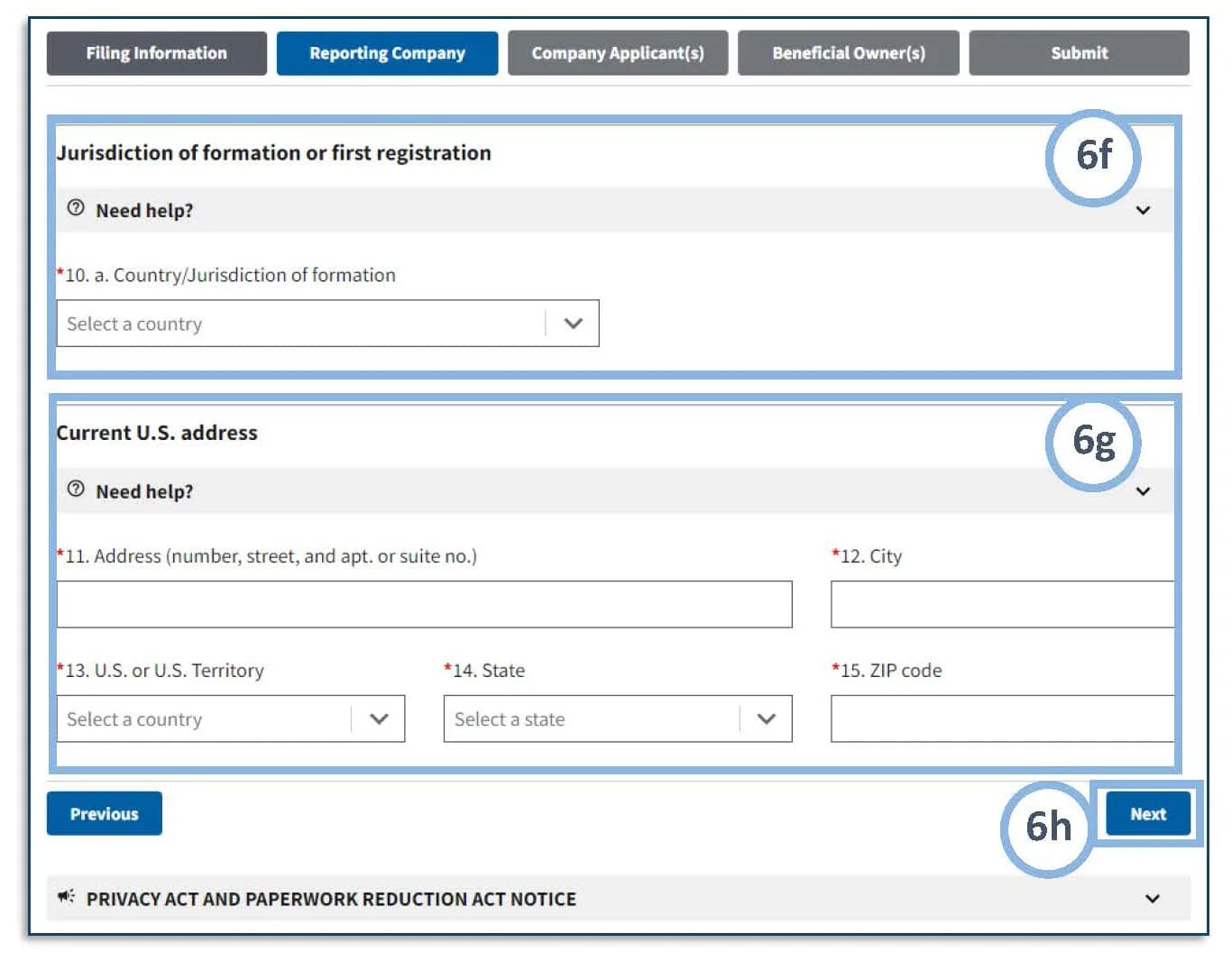
Part I: the company
- Legal name, plus any trade name, "doing business as" or "trading as" name.
- The street address of its principal place of business if that’s in the US. If not, the address of the primary US location where it conducts business.
- Its foreign jurisdiction of formation.
- The US state or tribal jurisdiction where it first registered.
- Its IRS taxpayer identification number (for most companies, an EIN). If it has none, a foreign tax ID and the name of the issuing country.
Part II: company applicants
There are at most 2: the person who directly files the US registration, and the person primarily responsible for directing that filing if more than one is involved (Q&A 8). US-person company applicants are exempt since the final rule, so a US formation agent or lawyer drops out (Q&A 9). A company registered before January 1, 2024 reports no company applicants at all (31 CFR 1010.380(b)(2)(iv)).
Part III: beneficial owners
A beneficial owner is an individual who, directly or indirectly, either exercises substantial control over the company or owns or controls at least 25% of its ownership interests (Q&A 7). Substantial control includes senior officers (president, CEO, CFO, COO, general counsel), anyone who can appoint or remove a senior officer or most of the board, and anyone who directs important decisions (31 CFR 1010.380(d)).
For each non-US beneficial owner and non-US company applicant, the report asks for:
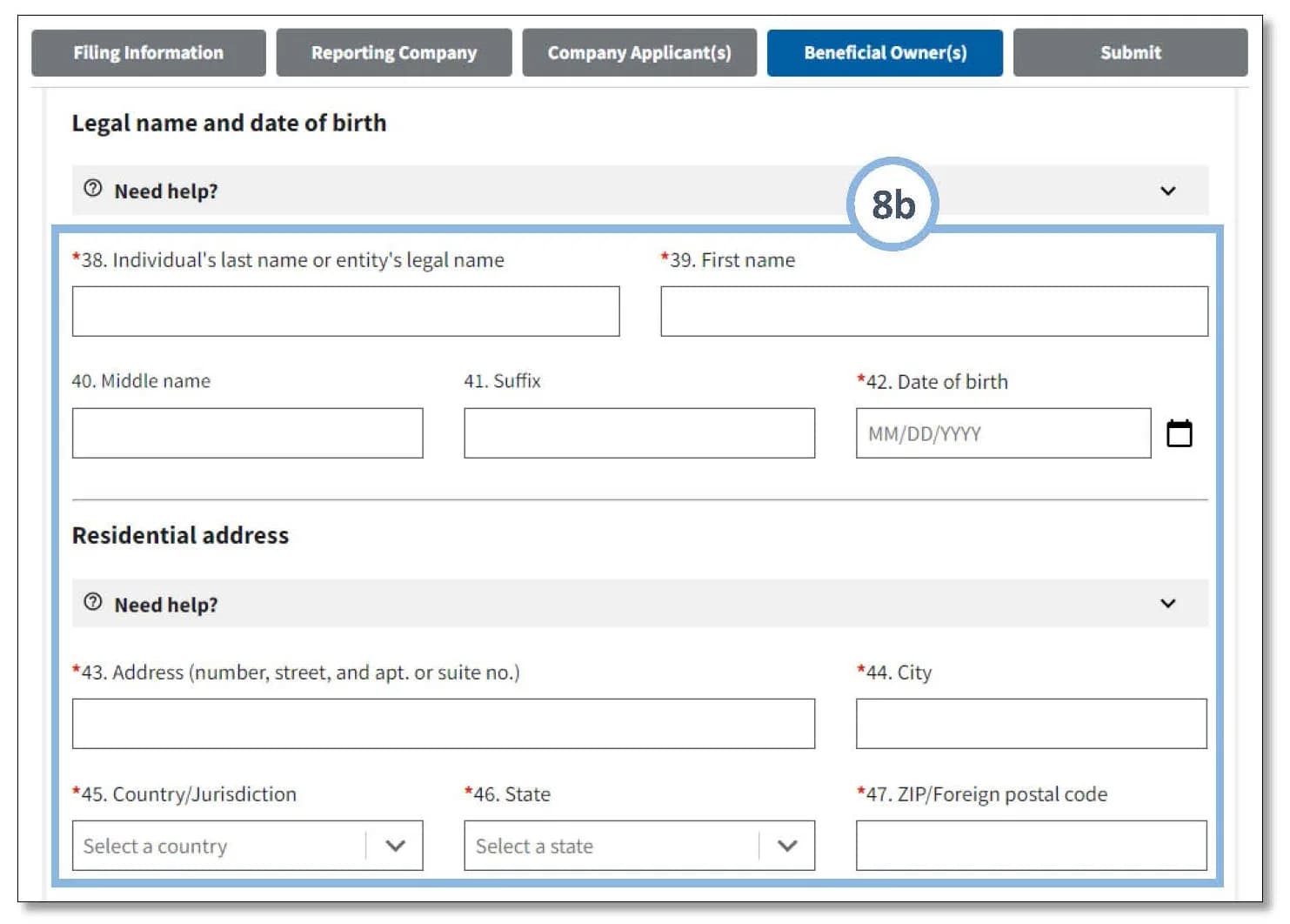
- Full legal name and date of birth.
- Residential street address. A company applicant who files in the course of their business gives that business’s address instead.
- The number and issuer of an unexpired ID, plus an image of it. The accepted IDs are a US passport, a state, local or tribal ID, a state driver’s license or, only if the person has none of those, a foreign passport (FinCEN FAQ F.5).
Address rules on a BOI report
The BOI report asks for 2 kinds of address, and the rule wants a street address for both (31 CFR 1010.380(b)(1)).
| Whose address | What the rule asks for | Can be outside the US? |
|---|---|---|
| The company | Street address of the US principal place of business, or of the primary US location where it conducts business | No |
| Non-US beneficial owner | Residential street address | Yes |
| Non-US company applicant | Business street address if filing in the course of business, otherwise residential | Yes |
PO boxes, mailboxes and registered agents
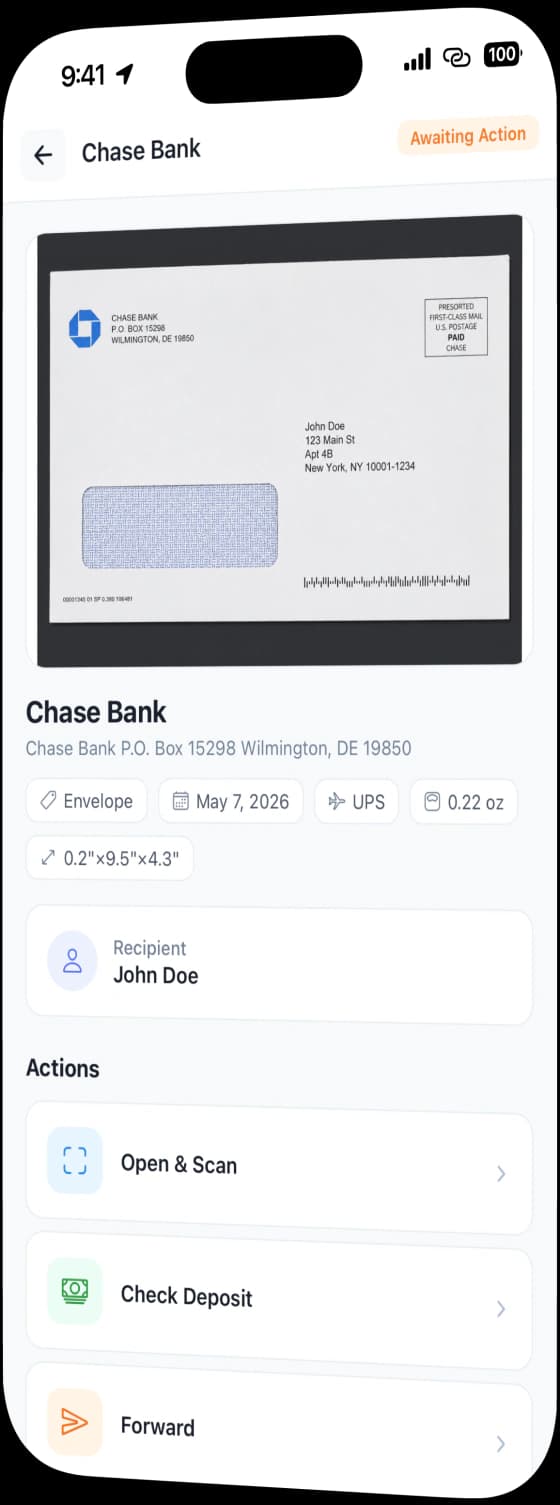
FinCEN is direct about one thing: a reporting company "cannot report a P.O. box as its current address" (FinCEN FAQ F.8). The rule text asks for the place where the company conducts business. A registered agent’s address or a mail-receiving address, such as a private mailbox (PMB), is where papers arrive, not where the company works. FinCEN hasn’t published separate guidance on either, so use the US street address where your business actually operates.
For a foreign company with no US office of its own, that’s the primary US location where it does business: a US office, a warehouse, or a staffed office it leases. If you need a real US office with a signed 12-month lease and a utility account in the company’s name, that’s what our Office plan is. A mailbox still has its place for receiving mail. Our CMRA address guide explains the difference.
How to file a BOI report with FinCEN
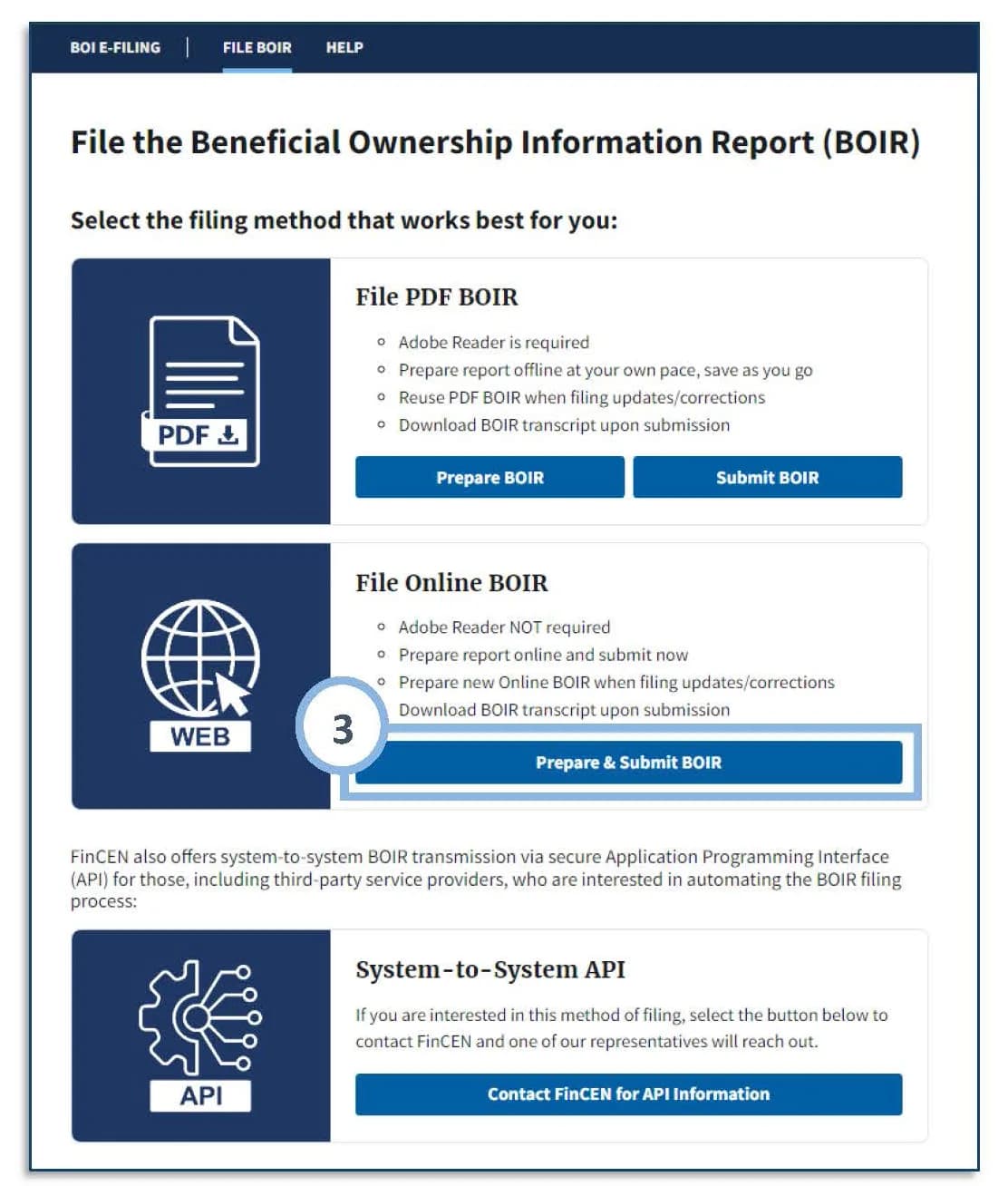
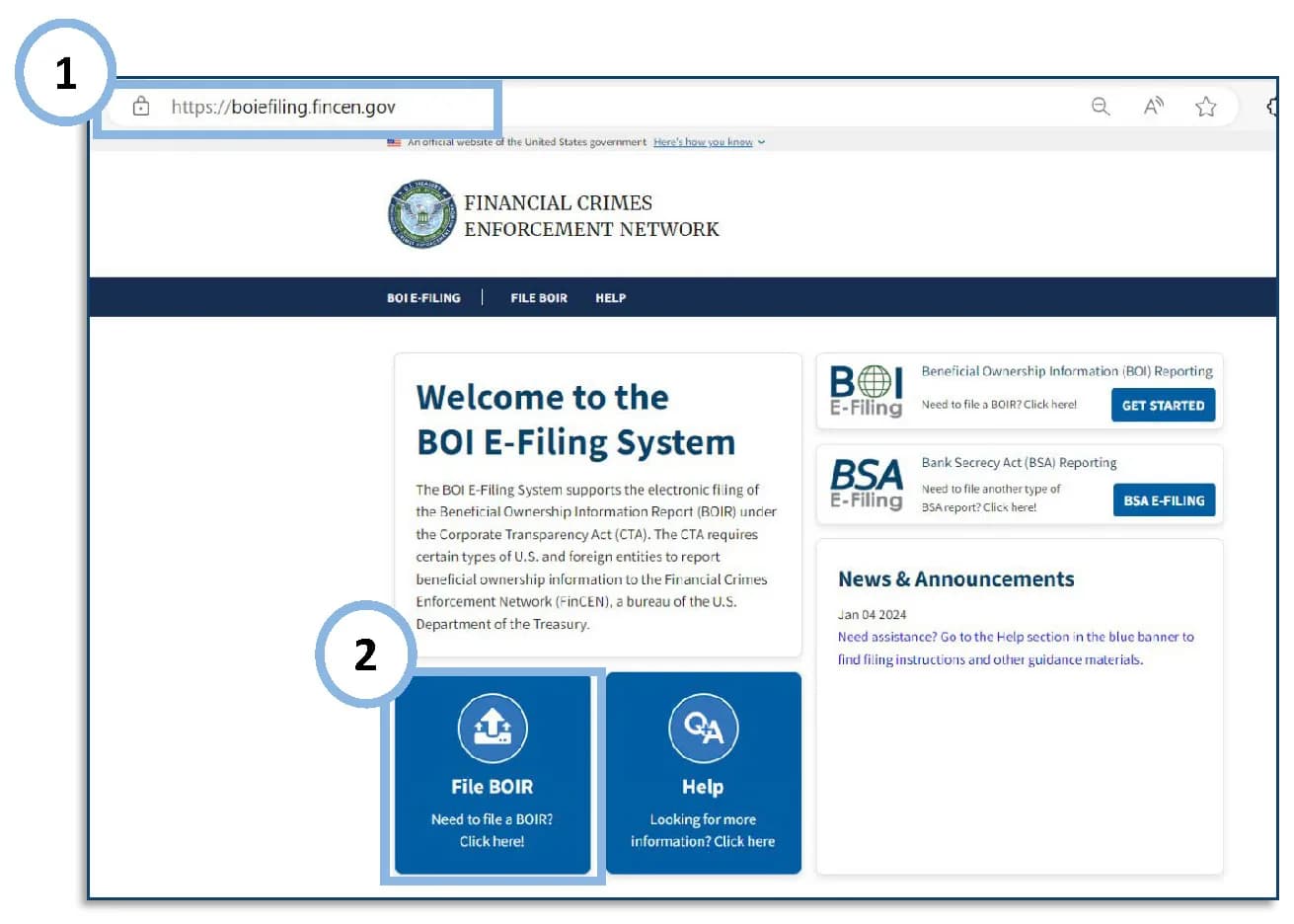
Filing is free and happens only through FinCEN’s BOI E-Filing site at boiefiling.fincen.gov. FinCEN says: "There is no fee for submitting your beneficial ownership information report" (FinCEN FAQ B.4). You can use the online form, a fillable PDF, or a system-to-system API meant for high-volume filers.
Step by step: the online BOI report
- 1Go to boiefiling.fincen.gov, choose File BOIR, then Prepare & Submit BOIR under the online option, and accept the government-system warning.
- 2Filing information: pick the report type. That’s an initial report, a correction, an update, or "newly exempt entity".
- 3Reporting company: enter the legal name and any DBA, the tax ID, the country of formation, the state of first registration and the current US street address.
- 4Company applicants: add each non-US applicant, or tick "existing reporting company" if the company registered before January 1, 2024.
- 5Beneficial owners: add each non-US beneficial owner with name, date of birth, residential address, ID details and an image of the ID. You can enter a FinCEN ID instead if the person has one.
- 6Submit: give the submitter’s name and email, certify the report, and submit.
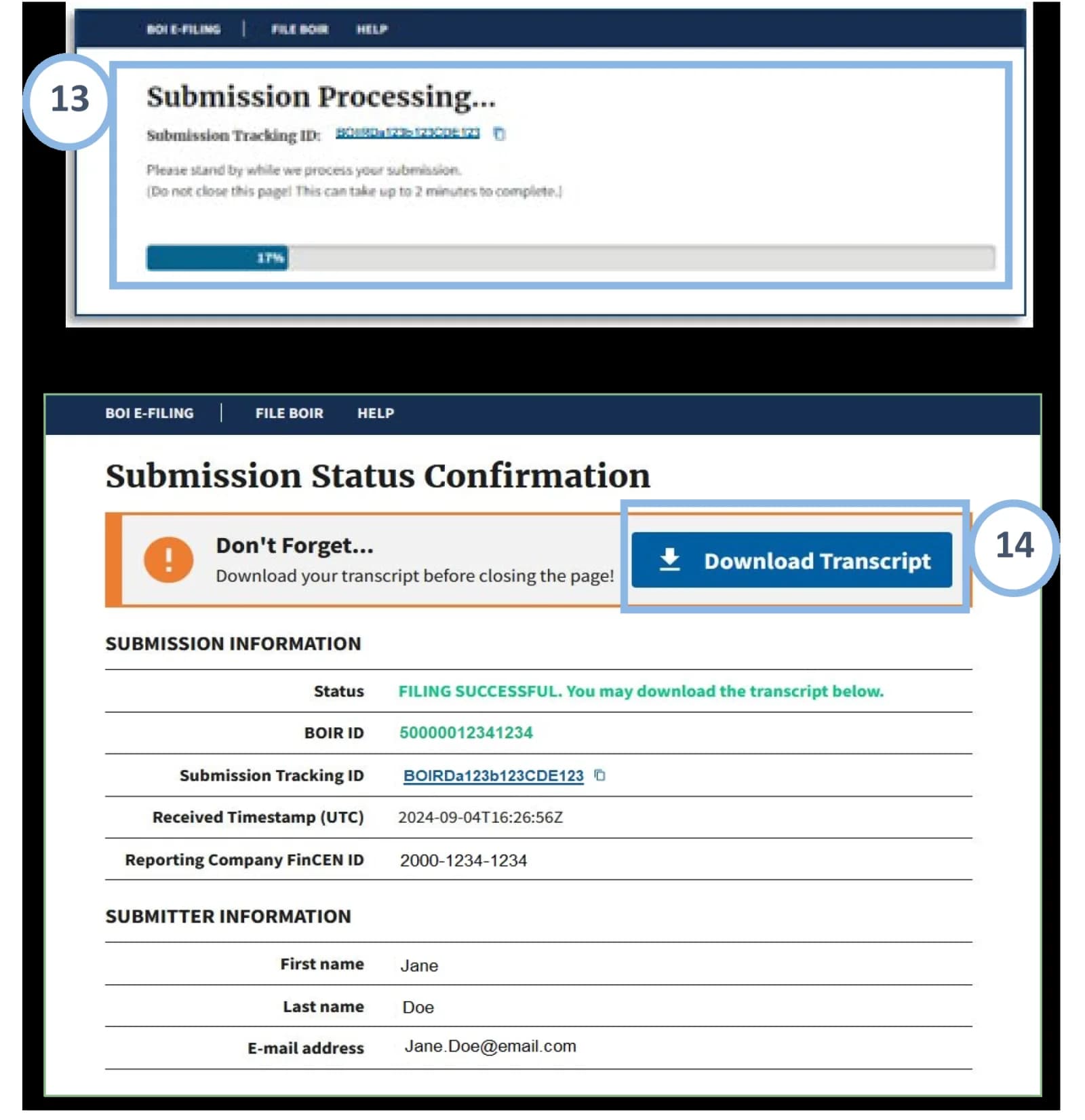
- 7Download the transcript before you close the page. It’s your proof of filing.
FinCEN IDs
A FinCEN ID is a number an individual or company can request once and then give in place of full details on BOI reports (Q&A 10). You apply at fincenid.fincen.gov. Since the final rule, US persons who already have one don’t have to keep it updated. Non-US holders still update within 30 days of a change and correct errors within 30 days of learning of them (Q&A 11).
BOI penalties and BOI scams
The penalties didn’t change. They now reach only foreign reporting companies and non-US persons, because US companies and persons have no obligation left to violate (Federal Register, 91 FR 52518).
| Violation | Penalty | Source |
|---|---|---|
| Willfully failing to file or update, or filing false information | Civil: up to $606 for each day the violation continues | 31 CFR 1010.821 |
| Same, criminal | Fine up to $10,000, up to 2 years in prison, or both | 31 USC 5336(h)(3)(A) |
The statute set the civil penalty at $500 a day. FinCEN adjusts it for inflation, and it has been $606 since January 17, 2025 (90 FR 5629). Many older articles still say $591, which was the 2024 figure.
Both penalties need willfulness. FinCEN wrote in the final rule that "enforcement actions would not be based on inadvertent mistakes or a lack of awareness of the reporting requirements" (91 FR 52519).
BOI scam letters
FinCEN warns about letters and emails that cite made-up forms such as "Form 4022" or "Form 5102", or that ask for payment to file (FinCEN). FinCEN charges nothing, and a US company has nothing to file. If a letter says your US LLC owes a BOI fee or penalty, check it against fincen.gov before you do anything.
What still applies to US companies
The BOI exemption removes one federal filing. Other beneficial ownership checks keep running.
Banks still ask who owns your company
FinCEN’s Customer Due Diligence (CDD) Rule requires covered financial institutions to identify and verify the beneficial owners of a company when it opens an account (31 CFR 1010.230). The final rule left it untouched. FinCEN calls it an "important part" of banks’ anti-money-laundering programs and names it as one reason it could exempt domestic companies (Q&A 6). FinCEN also says it will "refocus on the CDD Rule" now the reporting rule is final (91 FR 52519).
So no BOI report doesn’t mean no ownership check. Expect a bank or payment platform to ask for everyone with 25% or more, one controller, their IDs and a business address. Each platform sets its own address rules, so check theirs. We cover them in our guides to Mercury, Stripe and proof of address.
New York’s LLC Transparency Act
New York’s own law took effect on January 1, 2026. It covers non-exempt LLCs "formed under the law of a foreign country" that are authorized to do business in New York, and they file disclosure statements with the Department of State (NY DOS). The Department says LLCs formed in New York, another state or a US territory are exempt. Existing covered LLCs file by December 31, 2026, and new ones within 30 days of filing their application for authority (NY DOS FAQ).
The rule could change again
The domestic exemption comes from Treasury’s power to exempt entities under the CTA (31 USC 5336(a)(11)(B)(xxiv)), not from a change to the law itself. The CTA still stands: in December 2025 the Eleventh Circuit held it constitutional (NSBU v. Treasury). A future rule could narrow the exemption, so check fincen.gov/boi once a year.
How BOI reporting got here: a timeline
The rule changed several times. Many search results still describe an earlier stage, so here are the dates.
| Date | What happened |
|---|---|
| Sep 30, 2022 | FinCEN publishes the original Reporting Rule (87 FR 59498) |
| Jan 1, 2024 | Reporting begins for US and foreign companies |
| Dec 3, 2024 | A Texas federal court blocks the CTA nationwide in *Texas Top Cop Shop v. Garland* |
| Jan 23, 2025 | The Supreme Court stays that injunction. A second Texas order (*Smith v. Treasury*) keeps the rule paused |
| Feb 17, 2025 | The *Smith* court stays its own order and reporting is back on |
| Mar 2, 2025 | Treasury says it won’t enforce against US citizens or domestic companies (Treasury) |
| Mar 26, 2025 | Interim final rule exempts all US companies and US persons (90 FR 13688) |
| Dec 16, 2025 | The Eleventh Circuit upholds the CTA as constitutional |
| Aug 14, 2026 | Final rule makes the exemptions permanent and adds 2 more (Federal Register) |
| Feb 10, 2027 | US-person data in filings after this date won’t be deleted by FinCEN’s one-time sweep |
The court history comes from the final rule’s own footnotes (Federal Register). Treasury’s press release on the final rule is here.
BOI reporting checklist
Start at the top. Most readers stop after the first 2 lines.
Frequently asked questions
Is BOI reporting still required in 2026?
Only for foreign reporting companies. Under FinCEN’s final rule, effective August 14, 2026, US-formed companies and US persons are permanently exempt. Companies formed abroad and registered to do business in a US state still file.
Do I need to file BOI for my LLC?
Not if the LLC was formed in a US state. Every US-formed LLC is exempt, whoever owns it. Only an entity formed under another country’s law and registered in a US state files.
Does a foreign-owned US LLC have to file a BOI report?
No. The exemption depends on where the entity was formed, not on its owners’ nationality. A Wyoming or Delaware LLC owned by a non-US founder files nothing with FinCEN, though it may still owe IRS Form 5472.
What is a foreign reporting company?
A corporation, LLC or similar entity formed under the law of a foreign country that has registered to do business in a US state or tribal jurisdiction by filing with a secretary of state or similar office.
What is the BOI reporting deadline?
30 calendar days after a foreign company’s US registration takes effect. Foreign companies registered before March 26, 2025 had until April 25, 2025. Updates are due within 30 days of any change.
Was the Corporate Transparency Act repealed?
No. The CTA is still law and the Eleventh Circuit upheld it in December 2025. Treasury used the exemption power in the Act to take US companies and US persons out of the reporting rule.
What is the penalty for not filing BOI?
For a foreign reporting company that willfully fails to file, up to $606 a day in civil penalties, and criminal fines up to $10,000 with up to 2 years in prison. US companies face no BOI penalty because they have no filing duty.
Is there a fee to file a BOI report?
No. Filing directly with FinCEN at boiefiling.fincen.gov is free. FinCEN warns about scam letters that ask for payment or cite fake forms such as Form 4022.
I already filed BOI for my US company. Do I need to do anything?
No. You don’t need to update or withdraw it. FinCEN plans a one-time deletion of information it believes came from US persons and will post a notice when that is done. It won’t send individual confirmations.
Who is a beneficial owner for BOI?
An individual who owns or controls at least 25% of the company or exercises substantial control over it, such as a senior officer. Under the final rule, a foreign reporting company lists only beneficial owners who are not US persons.
Can I use a PO box or virtual address on a BOI report?
Not a PO box: FinCEN says a reporting company can’t report one. The rule asks for the street address where the company conducts business in the US, so a mail-receiving address isn’t the right entry.
Does the BOI exemption mean my bank won’t ask about owners?
No. FinCEN’s Customer Due Diligence Rule still requires banks to identify and verify a company’s beneficial owners at account opening. That’s separate from BOI reporting and unchanged.
Do I still need a FinCEN ID?
Only if you are a non-US person who wants to use one on foreign reporting companies’ reports. US persons who already have one don’t need to keep it updated under the final rule.