





You can summarize the following content using these AI tools:

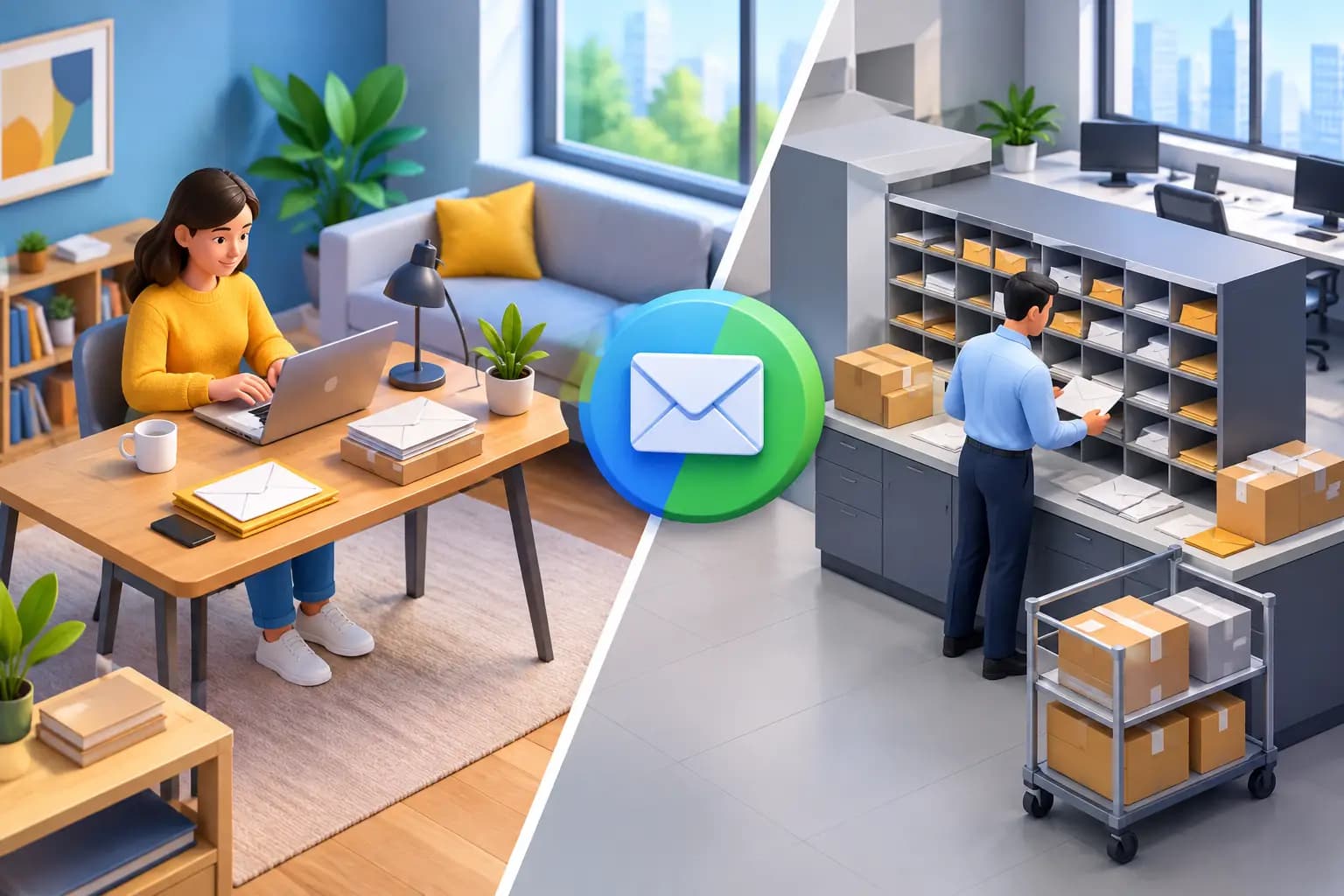
A lease renewal, a stack of unopened government notices, and a package waiting at reception can turn a simple office address into an expensive operational dependency. When comparing a remote mailroom vs physical office, the real question is not whether your business receives mail. It is whether you need to pay for a workplace just to stay in control of it.
For founders, remote teams, frequent travelers, and international operators building a U.S. presence, mail is still physical. Bank letters, state filings, tax notices, client checks, and verification documents do not stop arriving because your team works online. The right setup gives you a legitimate business identity and a reliable way to act on every item, wherever you are.
Remote Mailroom vs Physical Office: The Core Difference
A physical office combines several things under one roof: a business address, workspace, staff presence, meeting space, and a place to receive mail. That model works well when your team genuinely needs those resources every day.
A remote mailroom separates the mail and address function from the workspace. Your mail is received at a commercial street address, logged, and made actionable through a secure dashboard. You can request an exterior scan, have mail opened and digitized when appropriate, forward a package, shred sensitive documents, or arrange check deposit without traveling to a front desk.
The distinction matters because many modern businesses need a credible U.S. address and dependable mail handling, but do not need a permanent desk, utilities, furniture, or a multi-year commercial lease. A remote mailroom makes the physical side of business visible without forcing the business to be physically present.
When a Physical Office Still Makes Sense
A traditional office is not obsolete. It is a practical choice when the work itself depends on a shared location. A law firm with daily client appointments, a design studio that hosts presentations, a local service company with dispatch staff, or a growing team that benefits from regular in-person collaboration may need dedicated space.
In those cases, mail handling is simply one part of the office operation. Reception can accept deliveries, employees can process correspondence immediately, and clients have a place to visit. The higher overhead may be justified by the operational value of being together.
There are trade-offs. An office address can create a single point of dependency if only one employee has access to the mailbox or keys. Mail can sit unattended during travel, staffing changes, holidays, or an office move. It also exposes your workflow to the limits of business hours. A notice delivered at 4:45 p.m. Friday may not be seen until Monday.
For a team that needs a workplace, the strongest approach may be a physical office paired with clearly assigned mail processes. The office solves for collaboration. A defined workflow solves for accountability.
Where a Remote Mailroom Wins
A remote mailroom is designed for businesses that operate across locations but still need a stable, professional mailing presence. Instead of treating mail as something waiting in a lobby, it turns mail into a managed workflow.
Lower fixed costs without sacrificing legitimacy
Maintaining a physical office means paying for more than square footage. Rent, deposits, internet, furnishings, cleaning, insurance, utilities, reception coverage, and the cost of unused space all add up. Even a small office can become an outsized monthly commitment for a lean company.
A virtual mailroom subscription focuses your spending on the function you actually need: a commercial street address and controlled mail handling. For startups and solo operators, this can preserve capital for product development, marketing, contractors, or inventory. For global founders, it can establish a premium U.S. business identity without requiring a U.S. office lease.
Cost should not be the only decision factor. A low-cost address that cannot support your operational or verification needs may create problems later. Look for a provider that offers a real commercial location, USPS-compliant handling, and address documentation when your business needs formal proof of address.
Faster visibility for time-sensitive mail
Physical mail often contains deadlines. A state agency may request a response. A bank may send account verification. A vendor may send an original document or check. When mail is tied to one office, visibility depends on someone being there, opening it, and alerting the right person.
With a remote mailroom, arrival notifications create an immediate record that something has been received. From a secure dashboard, the account owner can decide what happens next. That could mean requesting a scan, forwarding the item to a home address or team member, securely destroying it, or keeping it stored for later action.
This is especially useful for founders who travel often and distributed teams that cannot rely on a single office manager. Every letter can be opened where the decision-maker is, not where the mailbox happens to be.
Better privacy for home-based businesses
Using a home address for a new LLC, public business registration, or customer correspondence can create an uncomfortable overlap between personal and professional life. It may also look less established to partners, clients, and suppliers.
A commercial business address gives your company a clearer boundary. It protects personal privacy while presenting a location that supports a professional public-facing identity. For many remote businesses, this is the most direct reason to move mail away from home.
Privacy still requires good internal discipline. Limit dashboard access to authorized users, use strong credentials, and set clear rules for who can request forwarding or document scans. The address is only one part of protecting business information.
Control across borders and time zones
International founders face an added challenge: U.S. mail may arrive while they are thousands of miles away. Asking a friend, contractor, or temporary office contact to sort sensitive correspondence is not a reliable long-term system.
A remote mailroom gives overseas operators a consistent U.S. point of receipt and a documented process for handling what arrives. Packages can be forwarded internationally when needed, while ordinary letters can be reviewed digitally based on the instructions you provide. That reduces delays, confusion, and the risk of a critical document being lost in an informal handoff.
The Compliance Question: Address, Documentation, and Use Case
Not every address product serves the same purpose. A P.O. box may work for receiving certain mail, but it is not always accepted where a physical commercial street address is required. Likewise, a basic mailbox may not provide the documents a founder needs for business formation, banking, payment processing, or verification.
Before choosing either option, identify what the address must do for your company. Will it appear on formation documents? Do you need to receive government notices? Will a bank, marketplace, or vendor request proof that your business is connected to the address? Do you need a signed commercial lease or utility bill to support verification?
A physical office may naturally produce lease and utility records, but only if you are the actual tenant and the documents meet the requesting institution's requirements. A dedicated business-address platform can be a better fit when it provides formal commercial address documentation as part of the service. Virtual Mail Hub is built for this use case, combining commercial street addresses, signed leases, utility bills, and remote mail controls in one subscription relationship.
No provider can guarantee acceptance by every bank, agency, or platform. Policies vary, and requirements can change. The practical move is to confirm requirements with the institution before you submit documents, especially for regulated accounts or state-specific filings.
How to Choose the Right Model
Choose a physical office when your business needs daily workspace, in-person service, local staff, or a permanent place for clients and operations to meet. The address is then one benefit of an office you already need.
Choose a remote mailroom when your business is remote-first, your team is distributed, your travel schedule is unpredictable, or your primary requirement is a professional address with secure mail control. It is also a strong fit when you need privacy, international access, package forwarding, or proof-of-address documentation without taking on an office lease.
Some businesses will use both. A company might maintain a small operational location while routing executive, compliance, or corporate mail through a centralized digital workflow. The goal is not to choose the most traditional setup. It is to make sure important mail is seen, assigned, and acted on without delay.
Frequently Asked Questions
Is a remote mailroom the same as a P.O. box?
No. A remote mailroom typically uses a real commercial street address and adds digital mail-management tools, such as arrival notifications, scan requests, forwarding, shredding, and package handling. A P.O. box is a mailbox at a post office and may not meet requirements that call for a commercial street address.
Can a remote mailroom receive government and bank mail?
A remote mailroom can receive mail addressed to your authorized commercial address, including many government and financial documents. Whether an institution accepts that address for a specific application, account, or verification process depends on its own policies. Confirm its requirements before relying on any address for compliance-sensitive use.
Is a physical office more secure than a remote mailroom?
Not necessarily. Security depends on the controls around access, handling, tracking, and disposal. A physical office can be secure with trained staff and documented procedures, but mail can also be misplaced or left unattended. A quality remote mailroom provides controlled intake, secure dashboard access, and instruction-based handling that creates more visibility for distributed owners.
Can I use a remote mailroom if I travel outside the United States?
Yes. This is one of its primary advantages. You can receive notifications, review requested scans, direct forwarding, and manage packages from abroad. A reliable U.S. address and clear handling instructions help you stay responsive when your work takes you far from the mailbox.
The best mail setup is the one that keeps your business reachable, credible, and ready to act - whether you are across town, across the country, or on the other side of the world.

