




You can summarize the following content using these AI tools:

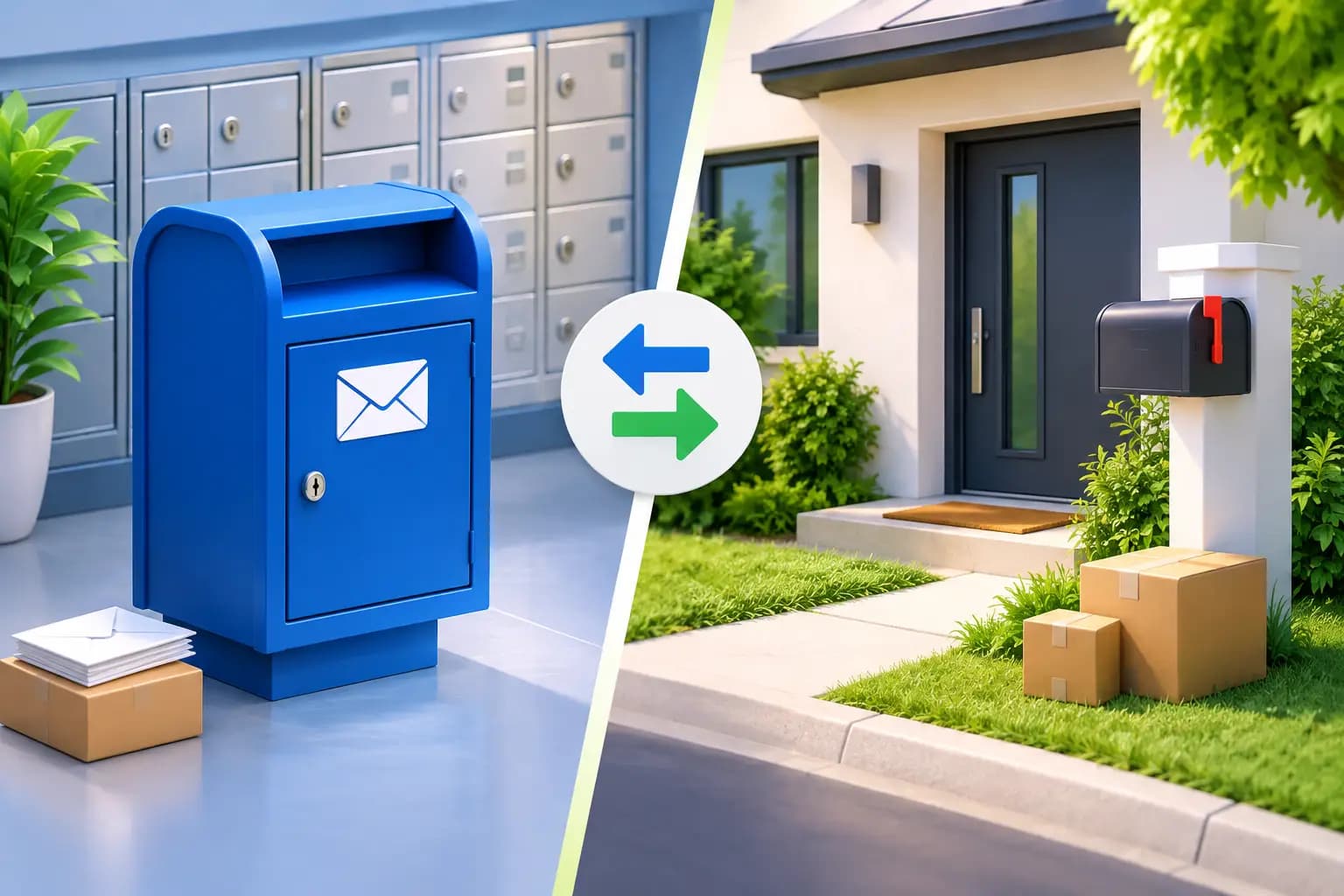
A government letter arrives while you are abroad. A supplier needs a delivery address. Your bank asks for proof of your business location. These are the moments when the PO box vs street address decision stops being a small mail preference and becomes part of your operating infrastructure.
For founders, freelancers, and remote teams, the right address affects more than where envelopes land. It shapes how credible your business appears, what kinds of deliveries you can receive, how you protect your home privacy, and how easily you can respond to compliance-sensitive mail from anywhere.
PO Box vs Street Address: The Core Difference
A PO Box is a locked mailbox located inside a post office. It is assigned and managed by the United States Postal Service, and its format identifies the box rather than a conventional office or commercial location. For straightforward USPS mail, it is familiar, private, and often inexpensive.
A street address identifies a physical location, such as a residence, office building, or commercial mail-receiving center. In a business context, a commercial street address can give customers, vendors, and institutions a more conventional address format while providing a place for mail and packages to be received.
That difference matters because many business workflows were designed around physical locations. Forms may ask for a street address and a separate mailing address. Delivery carriers may need a location where someone can accept a package. Financial institutions and government agencies may request documentation that ties a business to a verifiable commercial address.
A PO Box solves one problem well: receiving postal mail privately. A commercial street address can solve a broader set of problems when it is supported by legitimate mail handling, address documentation, and secure remote access.
When a PO Box Is the Right Choice
A PO Box remains useful for people whose needs are simple and local. If you receive a modest amount of USPS letter mail, live near the post office, and do not need packages from multiple carriers, it can be a practical option. It also keeps your home address off routine correspondence.
For a local consultant who only needs a stable place for invoices and occasional government notices, a PO Box may be enough. It is also a sensible backup mailing address for organizations that already have a staffed office and do not need their mailbox to represent their primary business location.
The trade-off is access. Someone usually needs to visit the post office to collect mail, and a PO Box does not automatically turn physical documents into a remote workflow. If you travel often, manage a distributed team, or live outside the United States, that pickup requirement can become a recurring operational gap.
Some post offices offer street-addressing options for certain deliveries, but availability and carrier acceptance vary. That can help in limited situations, yet it does not necessarily provide the commercial lease, utility bill, or formal location documentation a business may be asked to produce.
Where a Street Address Gives Your Business More Control
A commercial street address is often the stronger choice when mail is tied to growth, credibility, or verification. Customers can use a standard address format. Suppliers have a clearer delivery destination. Your business can separate its public identity from your home address without paying for a full-time office you do not use.
For remote-first businesses, the key benefit is not simply the address on a form. It is what happens after mail arrives. A modern virtual mailbox service receives the item, notifies you, and lets you decide what happens next through a secure dashboard. You can request an exterior scan, have eligible mail opened and digitized, forward a package, shred unwanted documents, or coordinate a check deposit without waiting to return home.
That turns physical mail into a managed workflow rather than a pile waiting in a box. Every decision has visibility, which is especially valuable when legal notices, renewal reminders, banking correspondence, and time-sensitive client documents arrive while your team is working across time zones.
A street address can also make package management easier. Private carriers commonly require or prefer a physical delivery location, and e-commerce operators may receive inventory samples, returns, prototypes, or equipment from several carriers. Always confirm carrier rules and the mailbox provider's package policies, including size limits, storage time, forwarding costs, and prohibited items.
Business Verification Is Where the Difference Becomes Clear
Business owners often discover address limitations during formation, banking, payment processing, insurance applications, or vendor onboarding. A form may accept a PO Box as a mailing address but still require a physical principal address. Another organization may accept a commercial mailbox address but request additional proof of occupancy or business presence.
There is no universal rule. Requirements differ by state, bank, marketplace, and agency. A street address is not a guarantee of approval, and it should never be used to misrepresent where your business operates. The practical goal is to use an address solution that accurately supports your business needs and provides documentation when an institution legitimately asks for it.
This is where a provider's infrastructure matters. For customers who need address evidence, Virtual Mail Hub offers commercial street addresses supported by signed commercial leases and utility bills. Those documents can help with business formation, banking, account verification, and other compliance workflows when appropriate for the institution's requirements.
Keep your address records consistent. Use the same legal business name, entity details, and address format across formation documents, tax records, bank profiles, and vendor accounts whenever the use case allows. Small mismatches can create manual reviews and delays.
Privacy Without Losing Professionalism
Using a home address for a new business feels easy until that address appears on invoices, public-facing records, return labels, or online directories. For solo founders, creators, and home-based operators, the concern is not only appearance. It is personal privacy.
A PO Box protects privacy, but it can signal that mail handling is separate from a physical business location. A commercial street address can preserve privacy while presenting a premium U.S. business identity that is more familiar to clients and partners.
The right setup depends on the role of the address. You may use one address for public business mail, another for a legally required physical address, and a registered agent for service of process where required. Do not assume a virtual mailbox replaces every legal or regulatory role. Confirm your state requirements and use each service for its intended purpose.
Security and Access Matter as Much as the Address
Mail often contains account numbers, tax information, contracts, checks, and identity documents. Choosing an address provider means trusting its process for receiving, storing, scanning, forwarding, and destroying those materials.
Look beyond the street address itself. Ask how incoming mail is logged, who can access your dashboard, whether permissions can be shared with a bookkeeper or operations lead, and how long physical items are stored. Review identity-verification requirements as well. USPS-authorized mail-receiving agencies generally require customers to complete USPS Form 1583 and provide acceptable identification before receiving mail on their behalf.
That verification is not friction for its own sake. It helps create a more accountable mail-handling relationship. Combined with clear scanning controls, forwarding instructions, and document-security practices, it gives remote businesses a reliable chain of custody for important correspondence.
A Simple Way to Choose
Choose a PO Box if your mail volume is low, USPS letters are your main concern, and you can collect mail locally. Choose a commercial street address if you need a more conventional business identity, expect deliveries from multiple carriers, want to manage mail remotely, or may need formal address documentation.
If you are comparing providers, focus on the actions you will need after mail arrives. Can you see an arrival notice quickly? Can you direct forwarding internationally? Can you securely destroy sensitive mail? Can your team access only the information they need? The strongest address solution is the one that keeps your business moving when you are not near the mailbox.
Frequently Asked Questions
Can I use a PO Box for my business address?
You can use a PO Box as a mailing address for many purposes. However, some banks, state filings, payment platforms, and delivery services require a physical street address as well. Check the requirement for the specific application before relying on a PO Box alone.
Is a virtual mailbox street address a real address?
A virtual mailbox can provide a real commercial street address where mail and packages are received on your behalf. It is not the same as leasing a dedicated office suite, and it should be described accurately. Whether it is accepted for formation, banking, or verification depends on the requesting institution and the documentation available.
Can a commercial street address receive packages?
Often, yes. Commercial mail-receiving locations can generally accept packages from major carriers, subject to the provider's policies. Confirm package dimensions, storage windows, forwarding options, fees, and any restricted items before sending high-value or oversized shipments.
Do I need to complete USPS Form 1583 for a virtual mailbox?
In most cases, yes. When a commercial mail-receiving agency accepts USPS mail for you, Form 1583 authorizes that arrangement and requires identity verification. Completing it accurately helps protect your mail and keeps your account ready for dependable remote management.
Which is better for a remote business: a PO Box or street address?
For a remote business that needs more than occasional letter mail, a commercial street address is usually more flexible. It can support a professional public presence, package handling, remote mail actions, and potentially proof-of-address requests. Choose the option that matches your actual business use, then make sure every important letter remains accessible wherever you land.